


A Comparative Snapshot of Global Central Bank Policy Rates and inflationary Dynamic-2024
Dr Farhad Reyazat – London School of Banking & Finance
Here is a comprehensive summary of global central bank policy rates.
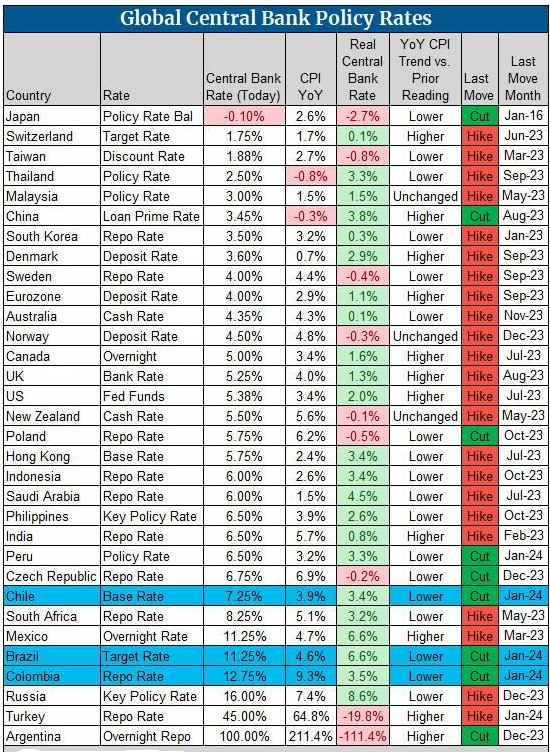
The above table explains:
- Policy Rates: The first column indicates the type of benchmark interest rate used by each country’s central bank.
- Central Bank Rate (Today): This column shows the current central bank rate for each country. These rates are the tools by which central banks influence their domestic economies. Negative rates in countries like Japan (-0.10%) and Switzerland (1.75%) suggest a very accommodative monetary policy, while very high rates in countries like Argentina (100.00%) suggest aggressive tightening to combat inflation.
- CPI YoY: The Consumer Price Index (CPI) year-on-year growth rate provides a measure of inflation. Many countries on this list are experiencing positive inflation, with some, like Turkey and Argentina, facing extremely high rates, indicating significant inflationary pressures.
- Real Central Bank Rate: This is the central bank rate adjusted for inflation. It provides a more accurate measure of the economic impact of interest rates. Negative real rates can suggest that the central bank is trying to stimulate the economy by keeping the cost of borrowing lower than the inflation rate.
- Trend vs. Prior: This column compares the current trend of the central bank’s policy rate with its previous direction. A ‘Higher’ trend suggests that the central bank is tightening monetary policy, possibly to combat inflation. A ‘Lower’ trend suggests easing to stimulate the economy.
- Last Policy Move: Indicates the most recent action by the central bank regarding the policy rate. ‘Hike’ means an increase, ‘Cut’ means a decrease, and ‘Unchanged’ means there was no change in the rate. The table shows a mixture of ‘Hike,’ ‘Cut,’ and ‘Unchanged,’ indicating diverse monetary policy responses.
- Last Move Date: The final column provides the date of the last policy rate move. Most recent moves appear to have been made in the months leading up to the date of this snapshot, suggesting a period of active monetary policy adjustments.
Overall Analysis:
- Tightening Cycle: A substantial number of central banks have increased their rates (‘Hike’) as their most recent policy move, suggesting a global trend towards tightening monetary policy. This is likely in response to increased inflation, as indicated by the positive YoY CPI figures.
- Inflationary Pressure: The CPI figures indicate that inflation is a concern for many countries, with some, like Turkey (64.8% YoY CPI) and Argentina (211.4% YoY CPI), experiencing hyperinflation.
- Negative Real Rates: Several countries are showing negative real rates, meaning their central bank rates, after adjusting for inflation, are below zero. This suggests an attempt to encourage economic activity by making borrowing cheap in real terms.
- Policy Rate Cuts: A few countries have recently reduced their rates (‘Cut’), indicating an effort to stimulate economic growth in the face of lower inflationary pressures or other economic challenges.
This table provides a snapshot of global monetary policy stances, illustrating how central banks are reacting to their respective economic situations. The varied responses highlight the different stages of economic cycles each country is in, with some tightening to cool down economies and control inflation, while others are easing to spur growth.
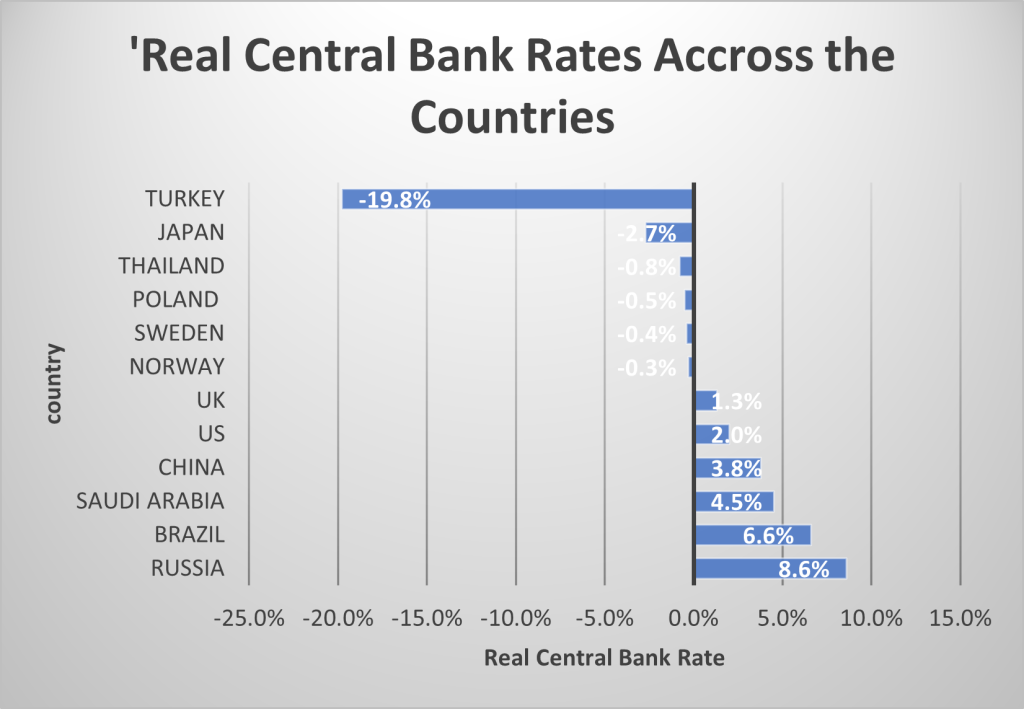
The above chart is comparing the ‘Real Central Bank Rate’ across various countries, with Turkey highlighted for having a significantly lower rate.
- Turkey: Turkey’s real central bank rate is shown as -19.8%, which is by far the lowest on the chart. A negative real interest rate suggests that Turkey’s central bank nominal rate is much lower than its current inflation rate. This can be a sign of an extremely accommodative monetary policy, often used to stimulate economic growth, but it can also indicate high inflation or even hyperinflation conditions that the nominal rate has not kept pace with.
- Thailand, Japan, Pland: These countries have negative real rates as well, though not as deeply negative as Turkey’s. Negative real rates can stimulate investment and spending because it reduces the cost of borrowing. However, if these rates are too low for an extended period, it can also lead to overheating of the economy or create asset bubbles.
- China: China’s real central bank rate is positive at 3.8%, indicating to encourage savings and help control inflation, but if set too high, it can slow down economic growth.
- Russia: With the highest positive real rate on the chart at 8.6%, Russia is likely aiming to control inflation of 7.4%, attract foreign investment, preventing capital flow and stabilise the currency. However, high real rates can also put a brake on economic growth and increase the cost of borrowing in Russian Economy.
In conclusion, this note provides a comprehensive overview of the global central bank policy rates, juxtaposing various monetary policy strategies against the backdrop of inflationary pressures. We see that while country like Japan maintains negative interest rates to stimulate economic activity, others such as Argentina have taken an aggressive stance with high rates to keep soaring inflation in check. The staggering 64.8% YoY CPI in Turkey and a whopping 211.4% YoY CPI in Argentina reflect the severe inflationary environments these countries are grappling with, necessitating distinct monetary policy responses.
The real central bank rates adjusted for inflation give a nuanced view of the economic impact of these interest rates. With Turkey’s real rate at a substantial negative -19.8%, it points to a central bank policy that is considerably more accommodative than the nominal rate would suggest, signaling efforts to invigorate economic growth or a reaction to high inflation levels that outpace the nominal rate adjustments. Conversely, China’s positive real rate of 3.8% and Russia’s 8.6%—the highest on the chart—illustrate policies designed to encourage savings and control inflation, albeit with a potential cost to economic growth and borrowing. Through the lens of these figures and facts, this artile underscores the diversity of monetary policy approaches. The central banks’ decisions reflect their attempts to navigate the complex interplay between fostering economic growth and ensuring price stability, each adapting to their unique economic challenges and cycles. Whether through rate hikes to cool down the economy and control inflation or through rate cuts to stimulate growth, the world’s central banks are treading cautiously into 2024. However with lower inflation and growth the main question is not if, but how much central banks will cut policy rates in 2024?




One reply on “A Comparative Snapshot of Global Central Bank Policy Rates and inflationary Dynamic-2024”
Amazing Content please publish more